


Free DP-300 pdf Files With Updated and Accurate Dumps Training
Top-Class DP-300 Question Answers Study Guide
NEW QUESTION # 278
You are building a database backup solution for a SQL Server database hosted on an Azure virtual machine.
In the event of an Azure regional outage, you need to be able to restore the database backups. The solution must minimize costs.
Which type of storage accounts should you use for the backups?
- A. locally-redundant storage (LRS)
- B. read-access geo-redundant storage (RA-GRS)
- C. geo-redundant storage
- D. zone-redundant storage (ZRS)
Answer: B
Explanation:
Geo-redundant storage (with GRS or GZRS) replicates your data to another physical location in the secondary region to protect against regional outages. However, that data is available to be read only if the customer or Microsoft initiates a failover from the primary to secondary region. When you enable read access to the secondary region, your data is available to be read if the primary region becomes unavailable. For read access to the secondary region, enable read-access geo-redundant storage (RA-GRS) or read-access geo-zone-redundant storage (RA-GZRS).
Incorrect Answers:
A: Locally redundant storage (LRS) copies your data synchronously three times within a single physical location in the primary region. LRS is the least expensive replication option, but is not recommended for applications requiring high availability.
C: Zone-redundant storage (ZRS) copies your data synchronously across three Azure availability zones in the primary region.
D: Geo-redundant storage (with GRS or GZRS) replicates your data to another physical location in the secondary region to protect against regional outages. However, that data is available to be read only if the customer or Microsoft initiates a failover from the primary to secondary region.
Reference:
https://docs.microsoft.com/en-us/azure/storage/common/storage-redundancy
NEW QUESTION # 279
You are building an Azure Stream Analytics job to retrieve game data.
You need to ensure that the job returns the highest scoring record for each five-minute time interval of each game.
How should you complete the Stream Analytics query? To answer, select the appropriate options in the answer area.
NOTE: Each correct selection is worth one point.
Answer:
Explanation:
Reference:
https://docs.microsoft.com/en-us/stream-analytics-query/topone-azure-stream-analytics
https://github.com/MicrosoftDocs/azure-docs/blob/master/articles/stream-analytics/stream-analytics-window-functions.md
NEW QUESTION # 280
You need to implement the surrogate key for the retail store table. The solution must meet the sales transaction dataset requirements.
What should you create?
- A. a system-versioned temporal table
- B. a table that has a FOREIGN KEY constraint
- C. a user-defined SEQUENCE object
- D. a table the has an IDENTITY property
Answer: D
Explanation:
Scenario: Contoso requirements for the sales transaction dataset include:
Implement a surrogate key to account for changes to the retail store addresses.
A surrogate key on a table is a column with a unique identifier for each row. The key is not generated from the
table data. Data modelers like to create surrogate keys on their tables when they design data warehouse models. You can use the IDENTITY property to achieve this goal simply and effectively without affecting load performance.
Reference:
https://docs.microsoft.com/en-us/azure/synapse-analytics/sql-data-warehouse/sql-data-warehouse-tablesidentity
NEW QUESTION # 281
You have an Azure SQL database named DB1 that contains two tables named Table1 and Table2. Both tables contain a column named a Column1. Column1 is used for joins by an application named App1.
You need to protect the contents of Column1 at rest, in transit, and in use.
How should you protect the contents of Column1? To answer, select the appropriate options in the answer area.
NOTE: Each correct selection is worth one point.
Answer:
Explanation:
Reference:
https://docs.microsoft.com/en-us/sql/relational-databases/security/encryption/always-encrypted-database-engine
NEW QUESTION # 282
You have an Azure subscription.
You need to deploy an Azure SQL managed instance by using an Azure Resource Manager (ARM) template.
The solution must meet the following requirements:
The SQL managed instance must be assigned a unique identity.
The SQL managed instance must be available in the event of an Azure datacenter outage.
How should you complete the template? To answer, drag the appropriate values to the correct targets. Each value may be used once, more than once, or not at all. You may need to drag the split bar between panes or scroll to view content.
NOTE: Each correct selection is worth one point.
Answer:
Explanation:
Explanation:
NEW QUESTION # 283
You have an Azure SQL database.
You have a query and the associated execution plan as shown in the following exhibit.
Use the drop-down menus to select the answer choice that completes each statement based on the information presented in the graphic.
NOTE: Each correct selection is worth one point.
Answer:
Explanation:
NEW QUESTION # 284
You have a new Azure SQL database named DB1 on an Azure SQL server named AzSQL1.
The only user who was created is the server administrator.
You need to create a contained database user in DB1 who will use Azure Active Directory (Azure AD) for authentication.
Which three actions should you perform in sequence? To answer, move the appropriate actions from the list of actions to the answer area and arrange them in the correct order.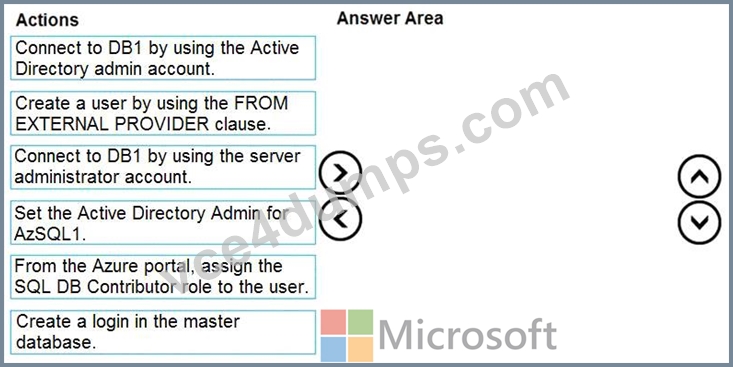
Answer:
Explanation:
Explanation
Step 1: Set up the Active Directory Admin for AzSQL1.
Step 2: Connect to DB1 by using the server administrator.
Sign into your managed instance with an Azure AD login granted with the sysadmin role.
Step 3: Create a user by using the FROM EXTERNAL PROVIDER clause.
FROM EXTERNAL PROVIDER is available for creating server-level Azure AD logins in SQL Database managed instance. Azure AD logins allow database-level Azure AD principals to be mapped to server-level Azure AD logins. To create an Azure AD user from an Azure AD login use the following syntax:
CREATE USER [AAD_principal] FROM LOGIN [Azure AD login]
Reference:
https://docs.microsoft.com/en-us/sql/t-sql/statements/create-user-transact-sql
NEW QUESTION # 285
You have two Azure virtual machines named VM1 and VM2 that run Windows Server 2019. VM1 and VM2 each host a default Microsoft SQL Server 2019 instance. VM1 contains a database named DB1 that is backed up to a file named D:\DB1.bak.
You plan to deploy an Always On availability group that will have the following configurations:
VM1 will host the primary replica of DB1.
VM2 will host a secondary replica of DB1.
You need to prepare the secondary database on VM2 for the availability group.
How should you complete the Transact-SQL statement? To answer, select the appropriate options in the answer area.
Answer:
Explanation:
Explanation
Graphical user interface, text, application, chat or text message Description automatically generated
Reference:
https://docs.microsoft.com/en-us/sql/database-engine/availability-groups/windows/manually-prepare-a-secondary
NEW QUESTION # 286
You have an Azure SQL managed instance named SQLMI1 that hosts 10 databases.
You need to implement alerts by using Azure Monitor. The solution must meet the following requirements:
Minimize costs.
Aggregate Intelligent Insights telemetry from each database.
What should you do?
- A. From the Diagnostic settings of each database, select Send to Log Analytics.
- B. From the Diagnostic settings of each database, select Stream to an event hub.
- C. From the Diagnostic settings of SQLMI1. select Stream to an event hub.
- D. From the Diagnostic settings of SQLMI1. select Send to Log Analytics.
Answer: A
Explanation:
Reference:
https://docs.microsoft.com/en-us/azure/azure-sql/database/metrics-diagnostic-telemetry-logging-streaming-export-configure?tabs=azure-portal#configure-the-streaming-export-of-diagnostic-telemetry
NEW QUESTION # 287
You have an Azure Data Factory pipeline that performs an incremental load of source data to an Azure Data Lake Storage Gen2 account.
Data to be loaded is identified by a column named LastUpdatedDate in the source table.
You plan to execute the pipeline every four hours.
You need to ensure that the pipeline execution meets the following requirements:
Automatically retries the execution when the pipeline run fails due to concurrency or throttling limits.
Supports backfilling existing data in the table.
Which type of trigger should you use?
- A. schedule
- B. event
- C. on-demand
- D. tumbling window
Answer: D
Explanation:
Explanation
The Tumbling window trigger supports backfill scenarios. Pipeline runs can be scheduled for windows in the past.
Reference:
https://docs.microsoft.com/en-us/azure/data-factory/concepts-pipeline-execution-triggers
NEW QUESTION # 288
You have an Azure subscription that is linked to an Azure AD tenant named contoso.com. The subscription contains an Azure SQL database named SQL 1 and an Azure web named app1. App1 has the managed identity feature enabled.
You need to create a new database user for app1.
How should you complete the Transact-SQL statement? To answer, select the appropriate options in the answer area.
NOTE: Each correct selection is worth one point.
Answer:
Explanation:
Explanation:
https://learn.microsoft.com/en-us/azure/app-service/tutorial-connect-msi-sql-database?tabs=windowsclient%
2Cef%2Cdotnet
NEW QUESTION # 289
You need to recommend a configuration for ManufacturingSQLDb1 after the migration to Azure. The solution must meet the business requirements.
What should you include in the recommendation? To answer, select the appropriate options in the answer area.
NOTE: Each correct selection is worth one point.
Scenario: Business Requirements
Litware identifies business requirements include: meet an SLA of 99.99% availability for all Azure deployments.
Box 1: Cloud witness
If you have a Failover Cluster deployment, where all nodes can reach the internet (by extension of Azure), it is recommended that you configure a Cloud Witness as your quorum witness resource.
Box 2: Azure Basic Load Balancer
Microsoft guarantees that a Load Balanced Endpoint using Azure Standard Load Balancer, serving two or more Healthy Virtual Machine Instances, will be available 99.99% of the time.
Note: There are two main options for setting up your listener: external (public) or internal. The external (public) listener uses an internet facing load balancer and is associated with a public Virtual IP (VIP) that is accessible over the internet. An internal listener uses an internal load balancer and only supports clients within the same Virtual Network.
Answer:
Explanation:
Reference:
https://technet.microsoft.com/windows-server-docs/failover-clustering/deploy-cloud-witness
https://azure.microsoft.com/en-us/support/legal/sla/load-balancer/v1_0/
NEW QUESTION # 290
You have an instance of SQL Server on Azure Virtual Machines named SQL1. SQL1 contains a database named DB1.
You need to enable Transparent Data Encryption (TDE) for DB1.
Which three objects should you create in sequence? To answer, move the appropriate objects from the list of objects to the answer area and arrange them in the correct order.
Answer:
Explanation:
Explanation:
NEW QUESTION # 291
You have an Azure virtual machine named VM1 on a virtual network named VNet1. Outbound traffic from VM1 to the internet is blocked.
You have an Azure SQL database named SqlDb1 on a logical server named SqlSrv1.
You need to implement connectivity between VM1 and SqlDb1 to meet the following requirements:
- Ensure that all traffic to the public endpoint of SqlSrv1 is blocked.
- Minimize the possibility of VM1 exfiltrating data stored in SqlDb1.
What should you create on VNet1?
- A. a VPN gateway
- B. an ExpressRoute gateway
- C. a private link
- D. a service endpoint
Answer: C
Explanation:
Azure Private Link enables you to access Azure PaaS Services (for example, Azure Storage and SQL Database) and Azure hosted customer-owned/partner services over a private endpoint in your virtual network.
Traffic between your virtual network and the service travels the Microsoft backbone network.
Exposing your service to the public internet is no longer necessary.
Reference:
https://docs.microsoft.com/en-us/azure/private-link/private-link-overview
NEW QUESTION # 292
You are designing an enterprise data warehouse in Azure Synapse Analytics that will store website traffic analytics in a star schema.
You plan to have a fact table for website visits. The table will be approximately 5 GB.
You need to recommend which distribution type and index type to use for the table. The solution must provide the fastest query performance.
What should you recommend? To answer, select the appropriate options in the answer area.
NOTE: Each correct selection is worth one point.
Answer:
Explanation:
Explanation
Graphical user interface, text, application, table, chat or text message Description automatically generated
Box 1: Hash
Consider using a hash-distributed table when:
The table size on disk is more than 2 GB.
The table has frequent insert, update, and delete operations.
Box 2: Clustered columnstore
Clustered columnstore tables offer both the highest level of data compression and the best overall query performance.
Reference:
https://docs.microsoft.com/en-us/azure/synapse-analytics/sql-data-warehouse/sql-data-warehouse-tables-distribu
https://docs.microsoft.com/en-us/azure/synapse-analytics/sql-data-warehouse/sql-data-warehouse-tables-index
NEW QUESTION # 293
You have an Azure SQL database named DB 1 in the General Purpose service tier.
You need to monitor DB 1 by using SQL Insights.
What should you include in the solution? To answer, select the appropriate options in the answer are a.
NOTE: Each correct selection is worth one point.
Answer:
Explanation:
NEW QUESTION # 294
You plan to develop a dataset named Purchases by using Azure Databricks. Purchases will contain the following columns:
ProductID
ItemPrice
LineTotal
Quantity
StoreID
Minute
Month
Hour
Year
Day
You need to store the data to support hourly incremental load pipelines that will vary for each StoreID. The solution must minimize storage costs.
How should you complete the code? To answer, select the appropriate options in the answer area.
NOTE: Each correct selection is worth one point.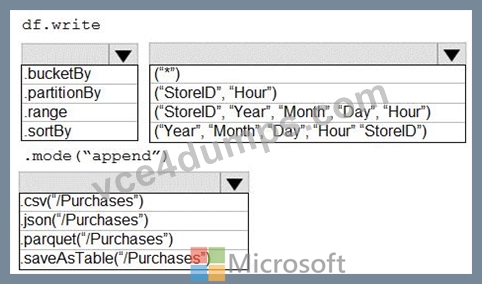
Answer:
Explanation:
Reference:
https://intellipaat.com/community/11744/how-to-partition-and-write-dataframe-in-spark-without-deleting-partitions-with-no-new-data
NEW QUESTION # 295
......
Real Updated DP-300 Questions & Answers Pass Your Exam Easily: https://examboost.vce4dumps.com/DP-300-latest-dumps.html