


FCP_FGT_AD-7.6 Certification Overview - [Feb 13, 2026] Latest FCP_FGT_AD-7.6 PDF Dumps
The Best Fortinet FCP_FGT_AD-7.6 Study Guides and Dumps of 2026
Fortinet FCP_FGT_AD-7.6 Exam Syllabus Topics:
| Topic | Details |
|---|---|
| Topic 1 |
|
| Topic 2 |
|
| Topic 3 |
|
| Topic 4 |
|
| Topic 5 |
|
NEW QUESTION # 76
The HTTP inspection process in web filtering follows a specific order when multiple features are enabled in the web filter profile.
Which order must FortiGate use when the web filter profile has features such as safe search enabled?
- A. DNS-based web filter and proxy-based web filter
- B. FortiGuard category filter and rating filter
- C. Static URL filter, FortiGuard category filter, and advanced filters
- D. Static domain filter, SSL inspection filter, and external connectors filters
Answer: C
Explanation:
When multiple web filtering features are enabled, FortiGate processes HTTP inspection in the following order:
1. Static URL filter - checks requests against manually configured URLs or patterns.
2. FortiGuard category filter - classifies the website based on FortiGuard's web reputation and category database.
3. Advanced filters - applies additional options such as safe search enforcement, YouTube restriction, and keyword filtering.
NEW QUESTION # 77
Refer to the exhibit. Why is the Antivirus scan switch grayed out when you are creating a new antivirus profile for FTP?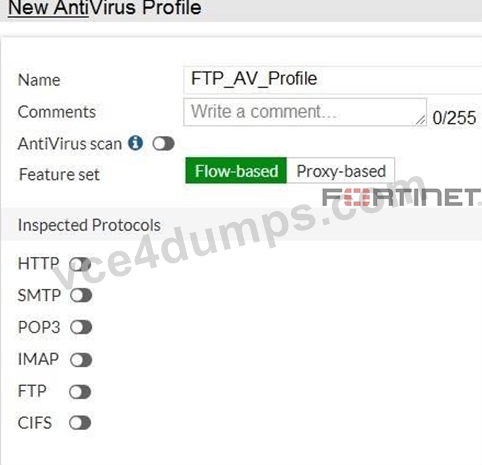
- A. FortiGate, with less than 2 GB RAM, does not support the Antivirus scan feature.
- B. The Feature Set for the profile is Flow-based but it must be Proxy-based.
- C. None of the inspected protocols are active in this profile.
- D. Antivirus scan is disabled under System -> Feature visibility.
Answer: C
Explanation:
The Antivirus scan switch is grayed out because none of the inspected protocols (HTTP, SMTP, POP3, IMAP, FTP, CIFS) have been enabled in the new antivirus profile. Until at least one protocol is turned on, FortiGate does not allow activation of the antivirus scan.
NEW QUESTION # 78
Refer to the exhibit.
A network administrator is troubleshooting an IPsec tunnel between two FortiGate devices. The administrator has determined that phase 1 status is up, but phase 2 fails to come up.
Based on the phase 2 configuration shown in the exhibit, which two configuration changes will bring phase 2 up? (Choose two.)
- A. On HQ-NGFW, enable Diffie-Hellman Group 2.
- B. On BR1-FGT, set Seconds to 43200.
- C. On BR1-FGT, set Remote Address to 10.0.11.0/255.255.255.0
- D. On HQ-NGFW. set Encryption to AES256
Answer: B,C
Explanation:
The key lifetime (Seconds) must match on both sides; BR1-FGT is set to 14400, so setting it to 43200 matches HQ-NGFW.
The remote address on BR1-FGT should match the HQ-NGFW's local subnet (10.0.11.0/24), but it is currently set incorrectly as 172.20.1.0/24. Changing it to 10.0.11.0/255.255.255.0 will align the Phase 2 selectors.
NEW QUESTION # 79
Refer to the exhibit.
What would be the impact of these settings on the Server certificate SNI check configuration on FortiGate?
- A. FortiGate will accept and use the CN in the server certificate for URL filtering if the SNI does not match the CN or SAN fields.
- B. FortiGate will close the connection if the SNI does not match the CN or SAN fields.
- C. FortiGate will close the connection if the SNI does not match the CN and SAN fields
- D. FortiGate will accept the connection with a warning if the SNI does not match the CN or SAN fields.
Answer: C
Explanation:
With the Server certificate SNI check set to Strict, FortiGate enforces that the SNI must match either the Common Name (CN) or Subject Alternative Name (SAN) in the server certificate; otherwise, it closes the connection.
NEW QUESTION # 80
Which two statements are true regarding FortiGate HA configuration synchronization? (Choose two.)
- A. Incremental configuration synchronization can occur from changes made on any FortiGate device within the HA cluster.
- B. Incremental configuration synchronization can occur only from changes made on the primary FortiGate device.
- C. Checksums of devices will be different from each other because some configuration items are not synced to other HA members.
- D. Checksums of devices are compared against each other to ensure configurations are the same.
Answer: B,D
Explanation:
In FortiGate HA (High Availability) configuration, checksums of device configurations are compared to ensure they are synchronized and identical across the cluster. Incremental synchronization can only happen from changes made on the primary device to ensure consistency and integrity across the cluster members.
Changes made on non-primary devices do not initiate synchronization.
NEW QUESTION # 81
Which two statements about the Security Fabric rating are true? (Choose two.)
- A. The root FortiGate provides executive summaries of all the FortiGate devices in the Security Fabric.
- B. A license is required to obtain an executive summary in the Security Rating section.
- C. The Security Posture category provides PCI compliance results.
- D. Security Rating Insights are available only in the Security Rating page.
Answer: A,B
Explanation:
A license is required to obtain an executive summary in the Security Rating section → Without the license, only limited Security Fabric rating details are shown.
The root FortiGate aggregates and provides executive summaries for all FortiGate devices in the Security Fabric, giving a consolidated security posture overview.
NEW QUESTION # 82
A network administrator enabled antivirus and selected an SSL inspection profile on a firewall policy. When downloading an EICAR test file through HTTP, FortiGate detects the virus and blocks the file. When downloading the same file through HTTPS, FortiGate does not detect the virus and does not block the file, allowing it to be downloaded.
The administrator confirms that the traffic matches the configured firewall policy. What are two reasons for the failed virus detection by FortiGate? (Choose two.)
- A. The El CAR test file exceeds the protocol options oversize limit.
- B. The selected SSL inspection profile has certificate inspection enabled.
- C. The website is exempted from SSL inspection.
- D. The browser does not trust the FortiGate self-signed CA certificate.
Answer: C,D
NEW QUESTION # 83
When configuring firewall policies which of the following is true regarding the policy ID?
- A. A policy ID cannot be edited once a policy is created.
- B. A firewall policy ID identifies the order of policy execution in firewall policies.
- C. It is mandatory to provide a policy ID while creating a firewall policy regardless of GUI or CLI.
- D. You can create a policy in CLI with policy ID 0.
Answer: A
Explanation:
Once a firewall policy is created, its policy ID is fixed and cannot be changed; this ID uniquely identifies the policy within the FortiGate configuration.
NEW QUESTION # 84
Refer to the exhibits. An administrator wants to add HQ-ISFW-2 in the Security Fabric. HQ-ISFW-
2 is in the same subnet as HQ-ISFW. After configuring the Security Fabric settings on HQ-ISFW-
2, the status stays Pending.
What can be the two possible reasons? (Choose two.)
- A. SAML Single Sign-On must be set to Manual.
- B. HQ-ISFW-2 must be authorized on HQ-ISFW.
- C. Upstream FortiGate IP must be set to 10.0.11.254.
- D. Management IP must be set to 10.0.13.254.
Answer: B,C
Explanation:
The Upstream FortiGate IP should match the IP address of the Fabric Root interface, which is
10.0.11.254, not 10.0.13.254.
The new device (HQ-ISFW-2) must be authorized on the Fabric Root (HQ-ISFW) before it can join the Security Fabric, otherwise the status remains pending.
NEW QUESTION # 85
A FortiGate administrator is required to reduce the attack surface on the SSL VPN portal.
Which SSL timer can you use to mitigate a denial of service (DoS) attack?
- A. SSL VPN idle-timeout
- B. SSL VPN http-request-header-timeout
- C. SSL VPN dtls-hello-timeout
- D. SSL VPN login-timeout
Answer: B
Explanation:
config vpn ssl settings
set http-request-header-timeout <1-60>
end
Timers can also help to mitigate DoS attacks with SSL VPN caused by partial HTTP requests.
NEW QUESTION # 86
Refer to the exhibit, which shows an SD-WAN zone configuration on the FortiGate GUI.
Based on the exhibit, which statement is true?
- A. The Underlay zone is the zone by default.
- B. The Underlay zone contains no member.
- C. The virtual-wan-link and overlay zones can be deleted.
- D. port2 and port3 are not assigned to a zone.
Answer: A
Explanation:
The Underlay zone is the default SD-WAN zone, typically representing the physical interfaces in the SD- WAN configuration before overlay or virtual links are added.
NEW QUESTION # 87
Refer to the exhibits. The exhibits show the application sensor configuration and the Excessive- Bandwidth and Apple filter details.
Based on the configuration, what will happen to Apple FaceTime if there are only a few calls originating or incoming?


- A. Apple Face Time will be allowed, based on the Apple filter configuration.
- B. Apple Face Time will be allowed only if the Apple filter in Application and Filter Overrides is set to Allow.
- C. Apple Face Time will be allowed, based on the Video/Audio category configuration.
- D. Apple Face Time will be blocked, based on the Excessive-Bandwidth filter configuration.
Answer: A
Explanation:
Apple FaceTime normally falls under Video/Audio and could be blocked by the Excessive- Bandwidth filter. However, in this configuration, an override is applied under the Apple vendor filter with Monitor action. Overrides take precedence over general filter actions. Therefore, FaceTime will not be blocked; instead, it will be monitored, and since only a few calls are made (not excessive bandwidth usage), it will be allowed based on the Apple filter configuration.
NEW QUESTION # 88
An administrator wants to configure dead peer detection (DPD) on IPsec VPN for detecting dead tunnels. The requirement is that FortiGate sends DPD probes only when there is no inbound traffic.
Which DPD mode on FortiGate meets this requirement?
- A. On Idle
- B. Enabled
- C. On Demand
- D. Disabled
Answer: C
Explanation:
Disable: Disable Dead Peer Detection.
On-idle: Trigger Dead Peer Detection when no IPsec traffic is received.
On-demand: Trigger Dead Peer Detection when no IPsec traffic is received AND FortiGate has been sending IPsec traffic. On-demand is the default setting.
NEW QUESTION # 89
Which two statements describe characteristics of automation stitches? (Choose two.)
- A. An automation stitch can have multiple triggers.
- B. Actions involve only devices included in the Security Fabric.
- C. Multiple actions can run in parallel.
- D. Triggers can involve external connectors.
Answer: C,D
Explanation:
Automation stitches can execute multiple actions concurrently (in parallel).
Triggers for automation stitches can come from external connectors beyond just Fortinet devices.
NEW QUESTION # 90
Which two statements are correct when FortiGate enters conserve mode? (Choose two.)
- A. FortiGate halts complete system operation and requires a reboot to regain available resources.
- B. FortiGate refuses to accept configuration changes.
- C. FortiGate continues to transmit packets without IPS inspection when the fail-open global setting in IPS is enabled.
- D. FortiGate continues to run critical security actions, such as quarantine.
Answer: B,C
Explanation:
In conserve mode, FortiGate restricts configuration changes to preserve system stability.
When IPS fail-open is enabled, FortiGate continues forwarding traffic without IPS inspection during resource constraints (conserve mode).
NEW QUESTION # 91
When FortiGate performs SSL/SSH full inspection, you can decide how it should react when it detects an invalid certificate.
Which three actions are valid actions that FortiGate can perform when it detects an invalid certificate?
(Choose three.)
- A. Block & Warning
- B. Trust & Allow
- C. Allow & Warning
- D. Allow
- E. Block
Answer: B,D,E
NEW QUESTION # 92
Refer to the exhibit.
What would be the impact of these settings on the Server certificate SNI check configuration on FortiGate?
- A. FortiGate will accept and use the CN in the server certificate for URL filtering if the SNI does not match the CN or SAN fields.
- B. FortiGate will close the connection if the SNI does not match the CN or SAN fields.
- C. FortiGate will close the connection if the SNI does not match the CN and SAN fields
- D. FortiGate will accept the connection with a warning if the SNI does not match the CN or SAN fields.
Answer: C
Explanation:
With the Server certificate SNI check set to Strict, FortiGate enforces that the SNI must match either the Common Name (CN) or Subject Alternative Name (SAN) in the server certificate; otherwise, it closes the connection.
NEW QUESTION # 93
When configuring a FortiGate in a multi-WAN setup, why would an administrator enable session preservation on an interface?
- A. To make sure all sessions without source NAT enabled always use the primary WAN link
- B. To allow the FortiGate to dynamically change interfaces for all active sessions when a WAN link fails
- C. To ensure that existing SSL VPN connections remain on the same interface even if route changes occur
- D. To improve security by forcing users to authenticate again when the WAN link changes
Answer: C
Explanation:
Session preservation keeps active sessions, such as SSL VPNs, tied to the original interface to prevent disruption when WAN routes change.
NEW QUESTION # 94
What are two features of collector agent advanced mode? (Choose two.)
- A. In advanced mode, security profiles can be applied only to user groups, not individual users.
- B. Advanced mode uses the Windows convention - NetBios: Domain\Username.
- C. In advanced mode, FortiGate can be configured as an LDAP client and group filters can be configured on FortiGate.
- D. Advanced mode supports nested or inherited groups.
Answer: C,D
Explanation:
Advanced mode supports nested or inherited groups, allowing FortiGate to recognize users that belong to subgroups within AD.
In advanced mode, FortiGate can be configured as an LDAP client and apply group filters, giving more granular control over user authentication and authorization.
NEW QUESTION # 95
Refer to the exhibit. What can you conclude from the log shown in the exhibit?
- A. The IPS scan is paused by the IPS diagnostic command with bypass mode option 5.
- B. The IPS session scan is paused and reevaluating the packet because of a dirty flag.
- C. The IPS socket buffer is full and IPS engine needs more memory to create new sessions.
- D. The IPS socket buffer is full and IPS engine cannot decode a packet.
Answer: C
Explanation:
The log message IPS session scan paused, enter fail open mode indicates that the IPS socket buffer is full, meaning the IPS engine does not have enough memory to process new sessions.
As a result, FortiGate switches to fail-open mode, allowing traffic to pass (or temporarily dropping it) without full IPS scanning.
NEW QUESTION # 96
......
Valid FCP_FGT_AD-7.6 Exam Updates - 2026 Study Guide: https://examboost.vce4dumps.com/FCP_FGT_AD-7.6-latest-dumps.html